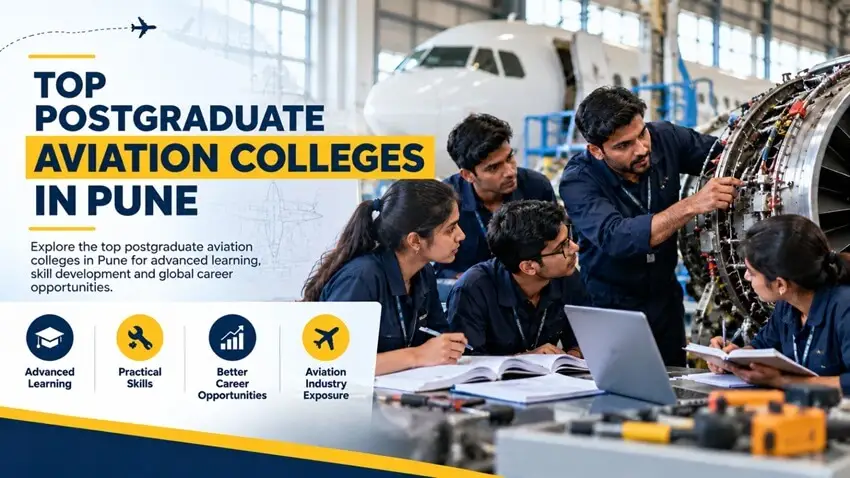
Explore top postgraduate aviation colleges in Pune, compare M.Sc. Aviation study options, understand eligibility and admission requirements, and discover important factors such as curriculum, academic affiliation, practical learning and career opportunities. Learn about the postgraduate aviation programme at IIAE Pune and how to choose a course that matches your academic background and career goals.
Top Postgraduate Aviation Colleges in Pune: Courses, Eligibility and Career Opportunities
Choosing the right postgraduate aviation college is an important step for graduates who want to build specialised knowledge and pursue professional opportunities in the aviation industry. Pune, Maharashtra, is an established higher education destination where students can explore aviation-related technical education and postgraduate study pathways.
Postgraduate aviation courses can cover subjects such as aviation science, avionics, aircraft systems, airport operations, aviation technology, research and related disciplines. However, not every aviation training institute offers a postgraduate degree. Students should carefully distinguish between postgraduate academic programmes, undergraduate aviation degrees and professional training courses before making an admission decision.
For graduates considering advanced aviation studies in Pune, Indira Institute of Aircraft Engineering (IIAE Pune) lists an M.Sc. Aviation programme on its official website. Understanding the programme, its curriculum, eligibility requirements and academic structure can help prospective students evaluate whether it matches their goals.
What Are Postgraduate Aviation Colleges?
Postgraduate aviation colleges and institutions provide advanced education for students who have completed an undergraduate qualification and want to specialise in aviation or a related field.
Depending on the programme, students may study aviation science, aircraft systems, avionics, aviation economics, airport operations, safety management, research methodology or other specialised subjects.
The qualification awarded depends on the institution and the course. An M.Sc. Aviation degree, a postgraduate engineering qualification, an aviation management degree and a professional Aircraft Maintenance Engineering training pathway are not interchangeable.
Before choosing a college, students should confirm the exact qualification offered, the academic affiliation, the applicable recognition or approvals, and the eligibility requirements for admission.
Why Consider Pune for Postgraduate Aviation Education?
Pune has an established higher education environment, with institutions offering programmes in science, engineering, technology and specialised professional fields. Students interested in aviation can investigate relevant educational options while comparing course content, facilities and academic requirements.
When searching for top postgraduate aviation colleges in Pune, it is important to look beyond promotional descriptions and assess each institution using consistent criteria.
Important factors include:
-
Availability of a relevant postgraduate degree.
-
Curriculum and specialisation options.
-
Academic affiliation and applicable recognition.
-
Faculty expertise and academic support.
-
Practical learning facilities and project opportunities.
-
Eligibility criteria and admission procedures.
-
Course duration, fees and additional expenses.
-
Opportunities for research and professional development.
Students should shortlist institutions that offer the qualification they actually want to pursue rather than assuming that every aviation institute provides postgraduate degree programmes.
IIAE Pune: An Option for M.Sc. Aviation
Indira Institute of Aircraft Engineering (IIAE Pune) lists a Master of Science (M.Sc.) in Aviation programme for eligible graduates interested in advanced aviation studies.
According to the institute's published programme information, the M.Sc. Aviation course is a two-year, full-time postgraduate degree divided into four semesters, with a total of 88 credits. The published programme information identifies Savitribai Phule Pune University as its academic affiliation and describes the curriculum as aligned with the National Education Policy 2020.
The curriculum covers technical, analytical and operational aspects of aviation. Published subject areas include principles and modelling of aviation science, avionics and embedded systems, aircraft structural integrity, aircraft maintenance practices, aircraft engine performance, drone technology and unmanned aircraft systems.
Other curriculum areas include aviation law and safety management, aviation cybersecurity, air traffic management, aviation reliability, flight simulation, data analytics and research projects.
The exact subjects and elective choices should be checked against the official syllabus applicable to the student's admission year.
Students can explore the programme through the official IIAE Pune website:
https://www.iiaepune.org/msc-aviation-course-pune
How to Identify the Right Postgraduate Aviation College in Pune
Selecting a suitable institution requires a careful comparison of its academic offering, learning environment and relevance to the student's goals.
1. Confirm the Qualification Offered
Begin by checking whether the institution offers a postgraduate degree in the subject you want to study. Some aviation institutions focus on undergraduate degrees, Aircraft Maintenance Engineering training or pilot-training preparation rather than postgraduate academic programmes.
Read the official course description and confirm the qualification awarded on completion.
2. Review the Academic Affiliation
Verify the university or awarding body associated with the course. Check the recognition or approvals applicable to the specific programme and the academic year in which you intend to enrol.
Do not assume that an institute's aviation-related training approval automatically applies to every degree it offers.
3. Compare the Curriculum
The curriculum should match your interests and previous education. Students interested in aviation technology may prioritise aircraft systems, avionics and engineering-related subjects, while those interested in operational or management work may look for relevant operational, analytical and organisational content.
Review the semester-wise syllabus, practical components, elective subjects and research requirements before deciding.
4. Evaluate Practical Learning
Practical learning can help students understand how academic concepts apply to aviation systems and operations. Depending on the programme, it may include laboratory work, technical simulations, research projects, demonstrations or supervised training.
Ask which facilities are available to enrolled students and which activities form part of the formal curriculum.
5. Understand Eligibility and Admission
Check the accepted undergraduate qualifications, minimum marks if applicable, required documents and any selection procedures.
A programme may accept graduates from specific scientific or engineering disciplines while another may have different entry conditions. Confirm your eligibility directly with the institution.
6. Compare Fees and Course Duration
Obtain the latest fee structure from the admissions office. Ask whether there are additional costs for examinations, laboratory work, practical training or other academic requirements.
Compare the total cost alongside the course duration, curriculum and facilities rather than choosing a college on fees alone.
7. Consider Career Relevance
Think about the professional direction you want to pursue after graduation. Evaluate whether the curriculum develops relevant knowledge and whether your intended role requires additional qualifications, licences or experience.
No postgraduate programme can guarantee employment or eligibility for every aviation occupation.
Important Subjects in Postgraduate Aviation Education
Postgraduate aviation programmes differ in their curriculum, but several subject areas can be relevant to advanced study in the field.
Aviation Science
Aviation science introduces students to scientific principles and analytical concepts used to understand aviation systems. It can provide a foundation for specialised technical and operational subjects.
Avionics and Embedded Systems
Avionics covers electronic systems used in aircraft, including instrumentation, communication and navigation technologies. Embedded systems involve specialised computing functions within larger technical systems.
These areas may interest students who want to understand aviation electronics and related technology applications.
Aircraft Structural Integrity
Aircraft structural integrity focuses on the strength, durability and performance of aircraft structures. Related subjects may involve structural analysis, materials and the assessment of engineering performance.
Aircraft Maintenance Practices and Engine Performance
These subjects explore maintenance principles, aircraft systems and engine performance assessment. Academic study in these areas does not automatically confer a professional aircraft maintenance licence or authorisation.
Drone Technology and Unmanned Aircraft Systems
Drone technology and unmanned aircraft systems involve uncrewed aircraft, their components, control systems and applications. Depending on the curriculum, students may study system design, simulation and operational considerations.
Aviation Law and Safety Management
Aviation law and safety management introduce students to regulatory frameworks, operational responsibilities and methods for identifying and managing safety risks.
Flight Simulation and Data Analytics
Flight simulation supports the study of aircraft behaviour and aviation systems in simulated environments. Data analytics helps students interpret technical and operational information to support analysis and decision-making.
Research Methodology
Research methodology develops the ability to formulate research questions, evaluate evidence, analyse information and present findings systematically. These skills are useful for academic projects and further research.
Students should consult the institution's official syllabus to confirm which subjects are included in their chosen programme.
Eligibility for Postgraduate Aviation Courses in Pune
Eligibility requirements depend on the institution and programme. Most postgraduate academic pathways require an undergraduate qualification, while specialised technical programmes may specify a particular subject background.
IIAE Pune's published M.Sc. Aviation information identifies graduates from aviation, science and related engineering backgrounds as potential candidates. Applicants should verify the current eligibility criteria before applying.
Prospective students should check:
-
Whether their bachelor's degree is accepted.
-
Whether a specific subject background is required.
-
Whether minimum aggregate marks or other academic conditions apply.
-
Whether additional examinations or selection procedures are necessary.
-
Which academic certificates and supporting documents must be submitted.
Students should not assume that all graduates qualify for every aviation postgraduate programme. Contacting the admissions team can help clarify eligibility before submitting an application.
Admission Process for M.Sc. Aviation at IIAE Pune
The admission process and requirements may vary by academic year. Students interested in the programme should follow the current instructions published by IIAE Pune.
A practical application process includes the following steps:
-
Review the official course page and latest syllabus.
-
Confirm that your undergraduate qualification meets the eligibility requirements.
-
Check the current course duration, fees and admission schedule.
-
Contact the admissions team if any entry requirements are unclear.
-
Prepare the required academic certificates and supporting documents.
-
Submit the application using the prescribed process.
-
Complete document verification and other admission formalities as instructed.
Applicants should verify seat availability, fees, deadlines and admission conditions directly with the institute. Information from an earlier academic year may not reflect current requirements.
Career Opportunities After Postgraduate Aviation Studies
Career opportunities depend on the qualification, specialisation, skills, relevant experience and requirements of individual employers. A postgraduate degree may support professional development, but it does not guarantee a particular job.
Aviation Operations
Graduates with relevant knowledge may explore operational planning, coordination, analysis and support roles within aviation organisations.
Airport Operations and Administration
Airport-related roles can involve administration, operational coordination, planning and support functions. Some positions require additional training or experience.
Aviation Technology and Avionics
Students with suitable technical qualifications may investigate opportunities involving aircraft electronics, aviation systems, embedded technologies or technical analysis.
Aircraft and Aerospace-Related Fields
Graduates with the appropriate engineering background may consider technical work involving aircraft structures, engineering analysis, system performance and related aerospace applications.
Drone Technology and Data Analysis
Depending on their skills, graduates may explore opportunities involving unmanned aircraft systems, simulation, technical support or aviation data analysis.
Research and Further Education
Students interested in academic or technical development may pursue research projects, specialised training or further study, subject to the relevant entry requirements.
The suitability of each career pathway depends on the student's actual qualification and the requirements of the employer or regulatory authority.
Why Consider IIAE Pune for Postgraduate Aviation Studies?
IIAE Pune is an aviation education institution that lists an M.Sc. Aviation programme on its official website.
The published programme information describes a two-year, full-time postgraduate degree with four semesters and 88 credits. Its curriculum includes technical and analytical subjects relating to aviation science, avionics, aircraft systems, drone technology, safety and research.
Students interested in the course can review the official syllabus and contact the institute to clarify the academic affiliation, eligibility criteria, fee structure, practical learning facilities and admission process.
Prospective applicants should verify the details applicable to their admission year and assess the programme against their academic background and professional goals.
For official programme information, visit:
https://www.iiaepune.org/msc-aviation-course-pune
Conclusion
Finding the right postgraduate aviation college in Pune involves comparing academic qualifications, curriculum, eligibility, practical learning opportunities and career relevance. Students should first establish which institutions offer the postgraduate degree they want and then assess each option using reliable, current information.
For eligible graduates interested in advanced aviation studies, the M.Sc. Aviation programme listed by Indira Institute of Aircraft Engineering (IIAE Pune) is worth exploring. Reviewing the latest syllabus and confirming admission requirements directly with the institute can help students make an informed decision about their next academic step.