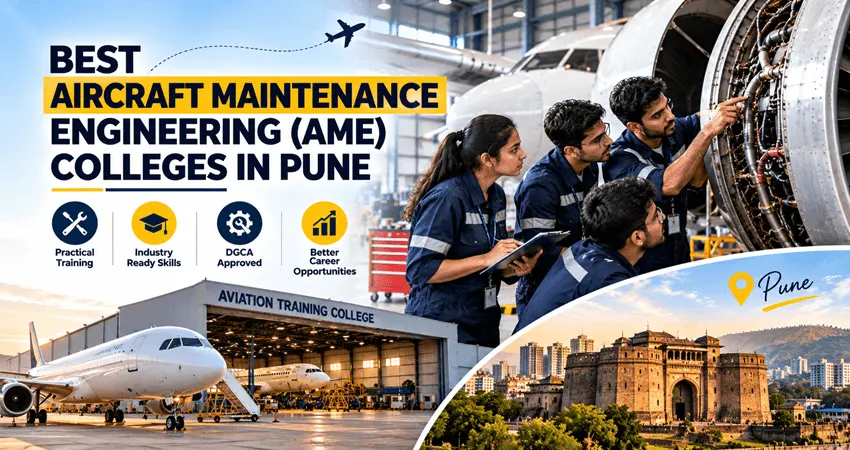
Explore the best Aircraft Maintenance Engineering (AME) colleges in Pune, compare DGCA approval, training facilities, course categories, practical exposure, eligibility, and career opportunities to choose the right AME institute.
Best Aircraft Maintenance Engineering (AME) Colleges in Pune
Choosing the right Aircraft Maintenance Engineering (AME) college is an important step for students who want to build a career in aircraft maintenance, aviation safety, and technical engineering. Pune is a city worth considering for aviation education because students can research specialist AME training institutes, compare course options, and explore the practical learning facilities available.
However, selecting an AME college should involve more than comparing advertisements or campus photographs. Students should carefully evaluate DGCA approval, the specific AME categories offered, practical training facilities, course structure, eligibility requirements, and industry exposure before making an admission decision.
In this guide, we explore some of the important AME college options in Pune and explain what students should check before choosing an institute.
What Is Aircraft Maintenance Engineering (AME)?
Aircraft Maintenance Engineering is a specialised aviation field concerned with the inspection, maintenance, troubleshooting, and airworthiness of aircraft and their systems. AME training combines theoretical knowledge with practical learning related to aircraft structures, engines, electrical systems, instruments, and aviation safety procedures.
Aircraft maintenance professionals work in a safety-critical environment. Their responsibilities depend on their training, qualifications, licence privileges, and applicable aviation regulations. For students who enjoy engineering, mechanical systems, electronics, and aviation technology, AME can be a career path worth exploring.
In India, students should understand the role of the Directorate General of Civil Aviation (DGCA) and the relevant Civil Aviation Requirements (CAR) when researching an AME training programme. A college's approval must be checked for the relevant training organisation and course category rather than assumed from the institute's name alone.
Best AME Colleges in Pune to Research
When comparing Aircraft Maintenance Engineering colleges in Pune, students should prioritise regulatory approval, course suitability, workshop and laboratory access, practical training arrangements, faculty expertise, and transparent admission information. The following institutes are starting points for research, not a definitive ranking.
1. Indira Institute of Aircraft Engineering (IIAE Pune)
Indira Institute of Aircraft Engineering, commonly known as IIAE Pune, is an aviation training institute located in Pune. Its official website describes its Aircraft Maintenance Engineering programmes under DGCA CAR-147 (Basic) approval, including B1.1 Aeroplane Turbine, B1.3 Helicopter Turbine, and B2 Avionics categories. Students should verify the current approval documents and authorised scope directly before enrolling.
IIAE Pune's published course information describes training that combines theoretical lessons with practical work. The institute lists facilities and learning activities related to airframes, jet engines, electrical and instrument systems, radio systems, composite materials, and non-destructive testing. These are useful areas to examine when comparing the practical component of an AME programme.
Students can also investigate the institute's aviation degree options and integrated programme pathways. Where a degree is included, confirm the awarding or affiliating university, the exact programme title, duration, and current affiliation status separately from the DGCA approval for AME training.
Why consider IIAE Pune?
-
Published AME training categories include B1.1, B1.3, and B2; confirm the current approved scope.
-
Practical learning facilities are described on the institute's official course curriculum page.
-
Students can enquire about the course structure, practical training arrangements, fees, and admission requirements.
-
The institute also publishes information about aviation programmes and industry-related training opportunities.
Official websites: https://www.iiaepune.org/ and https://www.iiaepune.org/Recognition-and-Approval
2. Pune Institute of Aviation Technology (Pune IAT)
Pune Institute of Aviation Technology, also known as Pune IAT, is another institute students can research when comparing AME education in Pune. Its official website describes Aircraft Maintenance Engineering training in B1.1 Aeroplane Turbine – Mechanical and B2 Avionics categories under DGCA CAR-147 (Basic).
The institute's published course page describes a full-time programme and provides eligibility details for students with a qualifying 10+2 science background or specified engineering diplomas. Applicants should verify the latest eligibility rules, approved course categories, course duration, and available seats directly with the institute and the relevant regulatory authority.
When comparing Pune IAT with other colleges, students should ask about practical workshop hours, access to training equipment, assessment procedures, industry exposure, student support, and how the programme prepares candidates for the applicable DGCA examinations and licensing requirements.
Official website: https://www.puneiat.edu.in/
How Should You Compare AME Colleges in Pune?
There is no single college that is automatically the best choice for every student. The right option depends on the student's preferred AME category, academic background, learning needs, budget, and career plans.
Use these criteria to make a practical comparison:
| Selection factor |
What to verify |
| DGCA approval |
Current CAR-147 (Basic) approval and the approved course categories |
| Course category |
Whether the institute offers the category you want to study |
| Practical facilities |
Access to relevant workshops, laboratories, equipment, and practical sessions |
| Course structure |
Duration, training hours, assessments, attendance rules, and syllabus |
| Industry exposure |
Details of internships, practical training arrangements, and industry partnerships |
| Degree pathway |
Exact degree title, university affiliation, and eligibility, where applicable |
| Total fees |
Tuition, examination charges, accommodation, uniform, and other expenses |
| Student support |
Faculty access, academic guidance, career support, and transparent outcomes |
Important AME Course Categories to Understand
Before choosing a college, students should understand the difference between common AME categories. The category determines the technical area covered by the training and the relevant regulatory pathway.
B1.1 – Aeroplane Turbine
B1.1 relates to turbine-powered aeroplanes and focuses on mechanical aircraft systems. Training may cover airframes, turbine engines, aircraft structures, and related mechanical systems. Students interested in aircraft mechanical maintenance can investigate this pathway.
B1.3 – Helicopter Turbine
B1.3 relates to turbine-powered helicopters. Its technical focus includes helicopter structures, turbine engines, and associated mechanical systems. Students interested in rotary-wing aircraft should confirm that the institute currently holds approval for this specific category.
B2 – Avionics
B2 focuses on aircraft electrical and electronic systems. Relevant subject areas can include instruments, electrical systems, communication equipment, and radio navigation systems. Students who enjoy electronics, electrical engineering, and troubleshooting may wish to explore this category.
Course availability and approval scope can change. Students should confirm the exact category listed on the current approval documentation before applying.
Eligibility for Aircraft Maintenance Engineering in Pune
Eligibility depends on the institute, course, and current regulatory requirements. AME programmes commonly consider students who have completed 10+2 with Physics, Chemistry, and Mathematics, while certain recognised engineering diploma qualifications may also be accepted under the applicable rules.
Applicants should check the latest admission criteria published by their chosen institute. They should also confirm any age requirements, medical or fitness conditions where applicable, document requirements, entrance or selection procedures, and the process for registering for relevant DGCA examinations.
Do not assume that eligibility for one AME category or institute automatically applies to another programme.
Course Duration and Training Structure
The duration of an AME programme depends on the approved course and institute. For example, IIAE Pune publishes a 2,400-hour training structure for its listed B1.1, B1.3, and B2 courses. Students should confirm the current duration and timetable for their intended programme directly with the institute.
AME education generally combines classroom instruction, practical training, assessments, and preparation for the applicable regulatory examinations. Students should understand how the programme allocates time to theoretical subjects and hands-on learning, what attendance requirements apply, and whether additional practical maintenance experience is required after the basic training stage.
Completing a course should not automatically be interpreted as holding an AME licence. Candidates must satisfy the applicable examination, experience, and licensing requirements under the relevant DGCA rules.
Practical Training Facilities: What Students Should Look For
Practical exposure is an important part of aircraft maintenance education. During college visits, students should ask to see the facilities used for their specific course category and learn how practical sessions are scheduled.
Useful facilities may include aircraft or component workshops, engine-related training equipment, electrical and avionics laboratories, instrument systems, airframe training resources, and safety-focused maintenance practice areas. The relevance and availability of these facilities should be checked against the actual course being offered.
Ask the admissions team questions such as:
-
How many practical training hours are included in the programme?
-
Which workshops and laboratories will students use?
-
Are practical sessions conducted on a regular timetable?
-
What safety procedures and supervision apply during workshop activities?
-
What practical training or maintenance experience is required after the course?
-
Can the institute provide current details of its training approvals and facilities?
These questions can help students evaluate whether the course offers the kind of learning experience they need.
Admission Process for AME Colleges in Pune
Although admission procedures differ between institutes, students can follow a few general steps when researching an AME programme.
First, shortlist colleges that offer the desired AME category. Next, check the latest eligibility criteria and collect the necessary academic documents. Contact the admissions office to confirm current fees, available seats, course duration, selection procedures, and the intake schedule.
Before paying any admission or booking amount, read the fee structure and refund policy carefully. Verify the institute's current approval documents and confirm whether any advertised degree is awarded by, or affiliated with, the university named in the programme details.
Students should retain written confirmation of fees, course details, and any promises relating to practical training or placements.
Career Opportunities After Aircraft Maintenance Engineering
AME training can help students prepare for technical career pathways within the aviation maintenance sector, subject to the qualifications, experience, examinations, and licences required for each role.
Potential areas to explore include aircraft maintenance organisations, airline engineering departments, maintenance, repair and overhaul (MRO) facilities, aircraft component workshops, and aviation technical support. The precise role a candidate can perform depends on their training, practical experience, regulatory authorisation, and employer requirements.
Students should research realistic entry-level opportunities and understand that course completion does not guarantee a job or a licence. When evaluating a college's placement claims, ask for clearly defined placement data, the reporting period, the roles offered, and the difference between placements, internships, and training arrangements.
AME Course Fees in Pune
AME course fees can vary by institute, course category, training structure, and the services included in the fee package. Additional expenses may include admission charges, examinations, learning materials, accommodation, transportation, uniforms, and other student costs.
Rather than relying on an estimated figure from an unrelated website, request the latest written fee structure from each shortlisted college. Compare the complete cost of the programme and ask whether fees are paid semester-wise, annually, or according to another schedule.
A clear fee comparison helps students assess affordability without overlooking important additional expenses.
Why Verify DGCA Approval Before Choosing an AME College?
Regulatory approval is one of the most important checks when selecting an AME training organisation in India. DGCA's CAR-147 (Basic) framework sets requirements for approved basic maintenance training organisations and their training programmes.
Students should verify that the institute's approval is current and covers the exact AME category they intend to study. They should also review the relevant official documentation rather than relying solely on promotional language, third-party listings, or an institute's general claim of being aviation-approved.
For regulatory information, consult the official DGCA website: https://www.dgca.gov.in/
How to Choose the Best AME College in Pune for Your Goals
Start by identifying whether you are more interested in aircraft mechanical systems, turbine-powered helicopters, or avionics. Then compare the current approvals, course structure, practical training facilities, eligibility requirements, fees, and student support of the institutes that offer your preferred category.
Visit the campus if possible, ask specific questions, and request written confirmation of important course details. If a programme includes a university degree, verify the degree and affiliation independently. If an institute advertises industry partnerships or placement support, ask what those arrangements mean for students in your particular batch.
For students researching AME education in Pune, IIAE Pune and Pune IAT are two options worth investigating through their official websites and current approval documentation.
Conclusion
Finding the best Aircraft Maintenance Engineering college in Pune requires careful research rather than relying on a ranking alone. Students should compare DGCA approval, the exact AME category offered, practical training, course duration, eligibility, fees, and career support before deciding.
IIAE Pune publishes information about its B1.1, B1.3, and B2 AME training programmes, while Pune IAT also provides information about its AME course offerings. Prospective students should verify current approvals and programme details directly with each institute before applying.
With the right research and a clear understanding of the training and licensing pathway, students can make a more informed decision about pursuing Aircraft Maintenance Engineering.