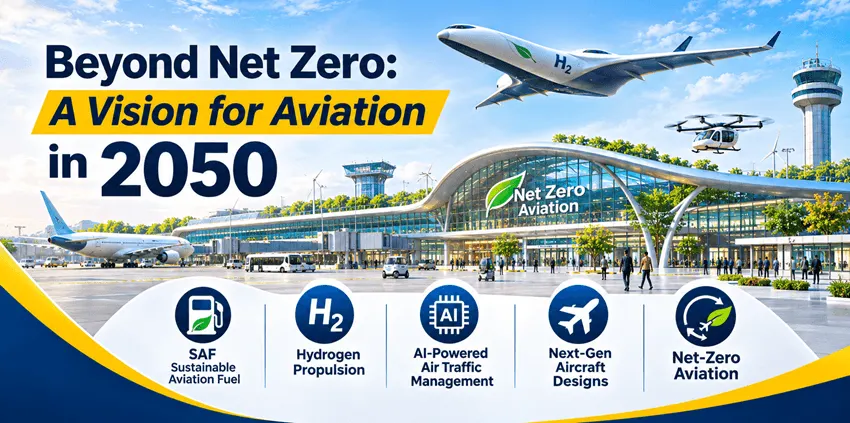
Discover the future of aviation in 2050, where Sustainable Aviation Fuel, hydrogen propulsion, AI-powered air traffic management, advanced aircraft designs, and smart airports transform the industry towards net-zero emissions.
What will the aviation industry look like in 2050?
By 2050, the aviation industry is envisioned to operate with significantly reduced carbon emissions through Sustainable Aviation Fuel (SAF), hydrogen propulsion, hybrid-electric aircraft, advanced blended-wing-body designs, and AI-powered air traffic management. Airports are also expected to become smarter mobility hubs, offering automated passenger services, electric air taxis, and personalized cabin experiences as the industry moves towards net-zero aviation.
Beyond Net Zero: A Vision for Aviation in 2050
Fast-forward to 2050. Discover how Sustainable Aviation Fuel (SAF), hydrogen propulsion, AI-driven air traffic management, and radical new aircraft designs have transformed the global aviation sector into a net-zero industry.
Picture this: It is a crisp Tuesday morning in 2050. You arrive at a gleaming, energy-positive airport terminal designed to be a seamless extension of the city. There are no long security queues; a contactless biometric scan confirms your identity as you walk through the entrance. Your bags are whisked away by autonomous robots to be loaded directly into a waiting aircraft.
You board a sleek, blended-wing-body airliner. As the engines spool up, you notice they are near-silent. There is a gentle hum, and you are airborne. Looking out the window, you realize there is no trail of emissions—only clear blue sky.
This isn't science fiction; it is the destination for the global aviation sector. Today, the industry is undergoing its most significant revolution since the dawn of the Jet Age, driven by the urgent imperative to reach net-zero carbon emissions by 2050.
Let’s explore the four pillars that define the face of aviation in 2050.
1. The Fuel Revolution: From Fossils to Renewables
The most profound change is how we power flight. In 2026, the industry was just beginning to scale up Sustainable Aviation Fuel (SAF). By 2050, conventional jet fuel (A-1) is largely a relic of the past for major commercial carriers.
Sustainable Aviation Fuel (SAF) Dominance
SAF, produced from renewable sources like municipal waste, agricultural residues, and eventually, atmospheric carbon capture (Power-to-Liquid), now accounts for over 70% of all aviation fuel consumed globally.
It is a "drop-in" fuel, meaning it powers the existing fleet of aircraft without modification, creating a massive lifecycle reduction in CO₂.
The Hydrogen Era
For short-to-medium haul routes, liquid hydrogen has emerged as the primary disruptor. Radical new aircraft designs, featuring cryogenic hydrogen storage tanks, enter service daily.
These "zero-emission at the tailpipe" aircraft—often recognizable by their bulbous fuselages or rear-mounted fuel cells—are quiet, efficient, and emit only water vapor.
2. Radical Aircraft Design and "More-Electric" Systems
Airbus, Boeing, and the next generation of aerospace manufacturers have completely rethought the physics of flight to achieve unprecedented efficiency.
Blended Wing Body (BWB) Airframes
The classic tube-and-wing design has been largely replaced by the BWB configuration.
This blended shape generates lift across the entire aircraft body, significantly reducing drag and fuel burn (or hydrogen consumption) by up to 20% per seat compared to 2026's most efficient jets.
Hybrid-Electric Propulsion
Regional aircraft (up to 100 seats) are now fully electric, powered by next-generation solid-state batteries that offer ten times the energy density of 2026 tech.
Larger long-haul aircraft use distributed hybrid-electric systems, where gas turbines (running on 100% SAF) generate electricity to drive multiple high-lift electric fans on the wings during takeoff and climb.
3. The AI-Powered Digital Sky
The skies of 2050 are far more crowded than today, yet they are managed with surgical precision, thanks to Artificial Intelligence and global connectivity.
Swarm Intelligence and NextGen ATC
Air Traffic Control (ATC) is no longer a ground-based, sector-by-sector process. It is a globally integrated, AI-driven system.
Aircraft share real-time data, "negotiating" optimal flight paths with each other (much like data packets on the internet) to avoid congestion and capitalize on upper-atmosphere tailwinds.
This "4D Trajectory Management" shaves crucial time and fuel off every journey.
Autonomous Flight Decks
While pilots remain on board for oversight, aircraft are capable of fully autonomous taxi, takeoff, cruise, and landing.
This not only enhances safety by removing human error but also enables more precise, fuel-efficient flight paths and optimal management of complex propulsion systems.
4. The Seamless Passenger Experience: Ground and Air
The airport experience has been utterly transformed from a source of stress into a hyper-efficient transit hub.
Airports as Mobility Hubs
The 2050 airport connects directly to high-speed rail networks and is a central node for Urban Air Mobility (UAM).
eVTOL (electric vertical takeoff and landing) "air taxis" shuttle passengers from city centers directly to their departure gate’s airside, bypassing the road network entirely.
Hyper-Personalized Cabins
The concept of distinct classes has evolved into a fully modular experience.
Cabins feature reconfigurable layouts that adapt to passenger needs—from lie-flat beds and private work pods for business travelers to expansive social lounges and immersive entertainment areas for families.
A Greener Horizon
Achieving net-zero by 2050 was—and remains—the industry's greatest challenge, requiring an estimated $1.5 trillion to $2 trillion in investment across infrastructure, technology, and R&D.
But looking back from 2050, it is clear that the effort was worth it. The aviation sector did not shrink; it evolved.
It continues to connect the world, foster cultural exchange, and drive global commerce—but it does so sustainably, ensuring that the freedom of flight can be enjoyed by generations to come.
Frequently Asked Questions
What is the vision for aviation in 2050?
The vision for aviation in 2050 is a more sustainable and technologically advanced industry focused on achieving net-zero carbon emissions. It includes sustainable fuels, hydrogen-powered aircraft, AI-driven operations, advanced aircraft designs, and smarter airports.
What role will Sustainable Aviation Fuel (SAF) play in the future of aviation?
Sustainable Aviation Fuel (SAF) is expected to play a major role in reducing aviation's lifecycle carbon emissions. It is produced from renewable sources such as municipal waste, agricultural residues, and atmospheric carbon capture.
How will hydrogen-powered aircraft change the aviation industry?
Hydrogen-powered aircraft could transform short-to-medium-haul aviation by using liquid hydrogen propulsion systems. These aircraft are envisioned to produce only water vapor at the tailpipe, helping reduce direct operational emissions.
How will Artificial Intelligence transform air traffic management by 2050?
Artificial Intelligence could make air traffic management more efficient through real-time aircraft data sharing, optimized flight paths, congestion avoidance, and 4D Trajectory Management. These systems could help reduce travel time and fuel consumption.
What technologies will make future airports more sustainable?
Future airports could use renewable energy, automated baggage handling, biometric passenger identification, high-speed rail connectivity, and electric vertical takeoff and landing (eVTOL) air taxis. These technologies aim to improve passenger convenience and operational efficiency.