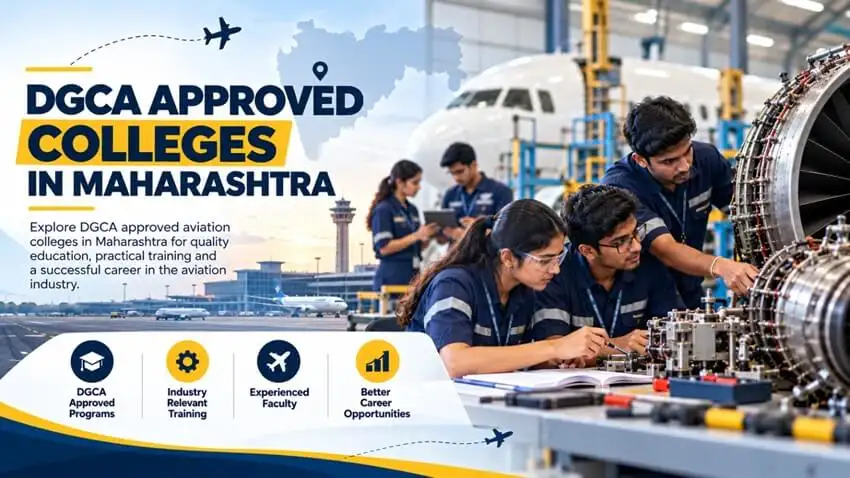
Explore DGCA approved colleges in Maharashtra for Aircraft Maintenance Engineering (AME). Compare available training categories, eligibility criteria, practical training, and admission requirements before choosing the right aviation institute.
DGCA Approved Colleges in Maharashtra
The aviation industry offers exciting career opportunities for students interested in aircraft technology, engineering, maintenance, and aviation safety. For students who want to build a career in Aircraft Maintenance Engineering (AME), choosing the right training institute is an important step. If you are searching for DGCA approved colleges in Maharashtra, it is essential to understand the available courses, approval requirements, training categories, eligibility criteria, and practical learning facilities before applying for admission.
Maharashtra is an important destination for technical and professional education, with Pune being one of the locations students can explore for aviation training. Indira Institute of Aircraft Engineering (IIAE Pune) and Pune Institute of Aviation Technology are two institutes whose official websites describe DGCA CAR-147 (Basic) AME training. Students should compare their preferred course categories and verify the latest approval details before making a final decision.
What Is a DGCA Approved College?
The Directorate General of Civil Aviation (DGCA) is the regulatory authority responsible for regulating important aspects of civil aviation in India. For students interested in Aircraft Maintenance Engineering, DGCA approval is an important factor when choosing a training institute.
Aircraft Maintenance Engineering training organisations approved under CAR-147 (Basic) operate according to applicable regulatory requirements for their approved training scope. Their programmes provide theoretical instruction and practical training related to aircraft structures, engines, electrical systems, avionics, maintenance procedures, and aviation safety.
However, students should understand that not every aviation institute offers the same courses or holds approval for the same training categories. Before applying, check whether the institute is approved for the specific AME category you want to pursue. Completing an AME training course does not automatically grant an AME licence; candidates must fulfil the applicable examination, practical experience, and other regulatory requirements.
Why Choose a DGCA Approved AME College in Maharashtra?
Selecting the right AME college can help students develop the technical knowledge and practical skills needed for the aircraft maintenance field. When comparing DGCA approved colleges in Maharashtra, students should consider several important factors.
DGCA Approval and Course Recognition
The first step is to verify the institute's current DGCA approval and the categories covered by it. An institute may offer multiple aviation programmes, but each course can have different approval or affiliation requirements. Checking the official documentation helps students understand the exact scope of the training they intend to pursue.
Practical Aircraft Maintenance Training
Aircraft maintenance requires both theoretical knowledge and practical experience. Students need to understand aircraft components, engines, electrical systems, instruments, maintenance tools, inspection procedures, and technical documentation. Training workshops, laboratories, aircraft-related equipment, and supervised practical sessions can help students develop a better understanding of these systems.
Experienced Faculty and Technical Guidance
Qualified instructors and structured technical guidance are important in aviation education. Students should enquire about faculty experience, teaching methods, laboratory sessions, practical assessments, and academic support. These factors can help them evaluate the overall learning environment of an institute.
Industry Exposure and Career Preparation
Exposure to aircraft maintenance environments can help students understand how maintenance organisations operate. When comparing institutes, ask about industry training arrangements, internships, practical exposure, and career guidance. Students should review the actual details of placement claims because employment depends on qualifications, practical experience, employer requirements, and other factors.
Top DGCA Approved Colleges in Maharashtra for Aircraft Maintenance Engineering
Students researching AME education in Maharashtra can begin by comparing institutes that publish information about their DGCA-approved training programmes. The following Pune-based institutes provide official information about their CAR-147 (Basic) AME training categories.
The list below is a starting point for research, not a complete statewide ranking. Students should verify current DGCA approval records and confirm the availability of their chosen category directly with the relevant institute before taking admission.
1. Indira Institute of Aircraft Engineering (IIAE Pune)
Indira Institute of Aircraft Engineering (IIAE Pune) is an aviation training institute located in Pune, Maharashtra. According to its official recognition and approval information, the institute is a DGCA-approved CAR-147 (Basic) Aircraft Maintenance Engineering Training Organisation offering training in B1.1 Aeroplane Turbine, B1.3 Helicopter Turbine, and B2 Avionics categories.
IIAE Pune also offers B.Sc. Aviation and M.Sc. Aviation programmes. Its official website identifies Savitribai Phule Pune University affiliation for its aviation degree programmes. Students interested in aircraft maintenance training and academic aviation education can explore the available courses and confirm the exact programme structure before applying.
Aircraft Maintenance Engineering Courses at IIAE Pune
B1.1 – Aeroplane Turbine (Mechanical): This category focuses on the mechanical maintenance of turbine-powered aeroplanes. Relevant areas include aircraft structures, turbine engines, mechanical systems, inspection methods, and maintenance procedures covered by the approved syllabus.
B1.3 – Helicopter Turbine (Mechanical): This category focuses on the mechanical maintenance of turbine-powered helicopters. Students study relevant helicopter systems, turbine engines, aircraft components, and maintenance procedures within the scope of the approved training programme.
B2 – Avionics: This category focuses on aircraft electrical and electronic systems. Relevant subjects include electrical installations, aircraft instruments, communication equipment, and navigation systems according to the applicable syllabus.
Students should confirm the latest approval scope, available seats, course duration, eligibility criteria, and admission requirements directly with IIAE Pune.
Practical Training and Learning Facilities at IIAE Pune
Practical learning is an important part of Aircraft Maintenance Engineering education. When evaluating IIAE Pune, students should enquire about its workshops, laboratories, aircraft-related training facilities, equipment, and arrangements for supervised practical sessions.
Students should also ask how practical training is organised for their chosen category and whether any external industry training is required. Understanding these details can help applicants assess how the programme combines classroom learning with technical practice.
Aviation Degree Programmes at IIAE Pune
In addition to AME training, IIAE Pune publishes information about B.Sc. Aviation and M.Sc. Aviation programmes. Students considering an academic qualification alongside technical training should check the admission requirements, course duration, university affiliation, and whether the programme is offered independently or as part of an integrated course.
The approval of an AME training programme and the affiliation of an academic degree are different matters. Applicants should verify both separately when comparing course options.
Who Should Consider IIAE Pune?
IIAE Pune may be worth considering for students interested in B1.1, B1.3, or B2 Aircraft Maintenance Engineering training. Students who also want to explore aviation degree programmes can enquire about the available B.Sc. Aviation and integrated AME options.
For official course and approval details, visit the IIAE Pune website.
2. Pune Institute of Aviation Technology (Pune IAT)
Pune Institute of Aviation Technology is another option students can explore when researching DGCA approved AME colleges in Maharashtra. According to its official website, the institute offers Aircraft Maintenance Engineering training under DGCA CAR-147 (Basic) in the B1.1 Aeroplane Turbine (Mechanical) and B2 Avionics categories.
The institute also provides information about its B.Sc. Aviation programme, which is affiliated with Savitribai Phule Pune University. Students should compare the available programmes and confirm which course best suits their educational background and career interests.
AME Course Categories at Pune IAT
B1.1 – Aeroplane Turbine (Mechanical): This category focuses on mechanical aircraft maintenance, including relevant aircraft structures, engines, mechanical systems, inspections, and maintenance procedures covered by the approved syllabus.
B2 – Avionics: This category focuses on aircraft electrical and electronic systems, including instruments and relevant communication and navigation equipment covered by the programme.
The institute's published AME course information describes a full-time programme with theoretical and practical training. Applicants should confirm the latest course duration, eligibility criteria, fee structure, practical training arrangements, and admission requirements directly with the institute.
Practical Learning and Industry Exposure at Pune IAT
Students comparing Pune IAT should enquire about the available workshops, laboratories, aircraft hangar facilities, training equipment, and practical learning arrangements. It is also important to understand how practical training is divided between institute facilities and any external maintenance organisation.
Before enrolling, applicants should clarify the practical training schedule, supervision, assessment process, and any additional costs associated with external training.
Who Should Consider Pune IAT?
Pune IAT may be suitable for students interested in the B1.1 or B2 AME categories and those exploring B.Sc. Aviation education. Students should compare the institute's current approval scope, course structure, practical training arrangements, and total fees with other available options.
For official course details, visit the Pune Institute of Aviation Technology website.
Understanding the Different AME Categories
Before choosing a college, students should understand the differences between the major AME categories available at the institutes they are considering. The right category depends on their interest in mechanical aircraft systems, helicopter maintenance, or aircraft electronics.
B1.1 – Aeroplane Turbine (Mechanical)
The B1.1 category focuses on the mechanical maintenance of turbine-powered aeroplanes. Training includes relevant aircraft structures, engines, mechanical systems, inspections, and maintenance procedures. Students interested in aircraft engines and mechanical components may wish to explore this specialisation.
B1.3 – Helicopter Turbine (Mechanical)
The B1.3 category relates to the mechanical maintenance of turbine-powered helicopters. The training covers relevant helicopter systems, turbine engines, and maintenance procedures included in the approved syllabus. Students interested in helicopter technology should check which institutes currently offer this category.
B2 – Avionics
The B2 category focuses on aircraft electrical and electronic systems. Relevant learning areas include aircraft instruments, electrical systems, communication equipment, and navigation systems. Students with an interest in electronics, electrical technology, and technical troubleshooting may find this specialisation worth exploring.
Not every institute offers all three categories. Always confirm that the category you want to study is included in the institute's current DGCA approval.
Eligibility Criteria for Aircraft Maintenance Engineering
Eligibility criteria depend on the institute, the programme, and the applicable admission requirements. Many AME training programmes require candidates to have completed Class 12 with Physics, Chemistry, and Mathematics from a recognised board or an equivalent qualification.
Some institutes also accept eligible engineering diploma holders in relevant branches, such as Mechanical, Electrical, Electronics, or Aeronautical Engineering. However, the accepted diploma branches and other conditions may vary between programmes.
Students should review the institute's current eligibility requirements before applying. It is also advisable to confirm any minimum marks, age-related conditions, medical requirements, entrance assessments, or additional documentation specified by the institute.
Admission Process for DGCA Approved Colleges in Maharashtra
The admission process can differ from one institute to another. However, students can follow these general steps when applying for an Aircraft Maintenance Engineering programme.
Step 1: Select Your Preferred AME Category
Begin by identifying whether you are interested in aeroplane mechanical maintenance, helicopter mechanical maintenance, or avionics. Understanding the categories will help you shortlist institutes that offer the training you want.
Step 2: Verify the Institute's DGCA Approval
Check the current approval documents and confirm that the institute is authorised to provide training in your preferred category. Do not rely only on general advertising statements or the phrase “DGCA approved.”
Step 3: Check Your Eligibility
Review the academic requirements for the selected course. Confirm whether your Class 12 qualification or engineering diploma meets the institute's current admission criteria.
Step 4: Compare Course Fees and Duration
Request the latest fee structure and course details. Ask whether the fees include practical training, examinations, equipment, uniforms, or other expenses. Also check for accommodation, transport, and any additional charges.
Step 5: Submit the Application
Complete the institute's application form and provide the required academic documents and identification. Follow the official instructions regarding application deadlines, admission confirmation, and fee payment.
Step 6: Confirm Practical Training Arrangements
Before finalising admission, understand where practical training takes place, how it is supervised, and what assessments are required. Ask about any external training arrangements and confirm whether additional costs apply.
Step 7: Understand the Licensing Requirements
AME training is one part of the professional pathway. Candidates must fulfil the applicable examination, practical experience, and regulatory requirements for the relevant licence. Make sure you understand these requirements before selecting a programme.
How to Choose the Best DGCA Approved College in Maharashtra
The best institute depends on a student's interests, educational background, budget, and preferred AME category. Comparing the following factors can help students make a well-informed decision.
Verify the Current DGCA Approval
Check the institute's applicable CAR-147 (Basic) approval and confirm that the category you intend to study is covered. Ask for the relevant documentation if the published information is unclear. Approval should be checked for the specific training scope rather than assumed to cover every course offered by the institute.
Evaluate Practical Training Facilities
Aircraft Maintenance Engineering is a practical technical field. Ask about the availability of workshops, laboratories, aircraft-related equipment, engines, components, and other training facilities. A campus visit can help you understand the learning environment and the resources available to students.
Compare the Course Structure
Review the course syllabus, duration, classroom teaching, practical sessions, examinations, and assessment requirements. Ensure that the programme matches your educational goals and provides the training scope you are looking for.
Understand the Total Course Fees
Request a written breakdown of the total course cost. Check tuition fees, examination charges, practical training costs, accommodation, transport, and any other applicable expenses. Comparing the complete cost is more useful than looking only at the initial admission fee.
Review Faculty and Student Support
Enquire about the qualifications and experience of the teaching staff, academic guidance, student facilities, and support for examinations. These factors can help you evaluate the quality of the learning environment.
Check Industry Exposure and Placement Support
Ask about practical training partnerships, industry visits, internships, and career guidance. Request clear details behind placement claims and understand whether they refer to eligible graduates, particular batches, or specific roles. Employment is not guaranteed simply by completing an AME programme.
Career Opportunities After Aircraft Maintenance Engineering
Aircraft Maintenance Engineering can provide a pathway towards technical careers in the aviation industry. The roles available to a candidate depend on their training category, qualifications, practical experience, examinations, and applicable regulatory authorisations.
Aircraft Maintenance Organisations
Aircraft maintenance organisations carry out inspections, servicing, repairs, and maintenance according to applicable procedures and regulatory requirements. Candidates with relevant AME training may explore suitable trainee or technical positions based on their qualifications and the employer's requirements.
Airlines and Maintenance, Repair and Overhaul Organisations
Airlines and maintenance, repair and overhaul (MRO) organisations require technical teams to maintain aircraft and support safe operations. Opportunities may be available in areas related to maintenance, technical support, inspections, and aircraft systems, depending on the candidate's experience and eligibility.
Avionics and Aircraft Electrical Systems
Students who pursue the B2 Avionics category may explore roles related to aircraft electrical and electronic systems. Depending on their qualifications and experience, their work may involve aircraft instruments, communication equipment, navigation systems, and associated troubleshooting activities.
Helicopter Maintenance
Students pursuing the B1.3 category may explore opportunities associated with turbine-powered helicopter maintenance. Specific roles depend on employer requirements, relevant practical experience, and the regulatory authorisations required for the position.
Technical Services and Maintenance Planning
With appropriate qualifications and experience, aviation professionals may also explore roles involving maintenance planning, technical documentation, quality processes, and aircraft maintenance support. The suitability of these roles depends on the position's requirements and the individual's professional development.
Why Practical Training Is Important in AME Education
Aircraft maintenance involves complex technical systems and strict safety requirements. Practical training helps students understand how theoretical concepts are applied to aircraft components, inspections, and maintenance tasks.
Through supervised practical sessions, students can develop familiarity with tools, technical documentation, aircraft systems, inspection methods, and maintenance procedures. Workshops and laboratories also provide opportunities to understand troubleshooting processes and the importance of following approved instructions.
When comparing DGCA approved colleges in Maharashtra, students should look beyond course titles. They should review the facilities available for their chosen category, the practical training schedule, and the arrangements for any external industry exposure.
Documents to Check Before Taking Admission
Before confirming admission, students should request and review the documents relevant to their selected programme. These may include the institute's current DGCA approval certificate, the approved AME training categories, the official course structure, eligibility criteria, a written fee breakdown, and the admission terms.
Students considering a degree programme alongside AME training should also verify the degree's university affiliation and the specific programme under which the qualification is awarded. DGCA approval for an AME training organisation and university affiliation for an academic degree are separate matters and should be checked independently.
Keeping copies of the relevant documents and written confirmations can help students understand the terms of admission and make an informed decision.
Conclusion
Choosing among DGCA approved colleges in Maharashtra requires careful consideration of regulatory approval, AME categories, practical training, eligibility, course fees, and career goals. Indira Institute of Aircraft Engineering (IIAE Pune) and Pune Institute of Aviation Technology are two institutes students can explore when researching AME training options in the state.
The right college depends on your preferred specialisation, academic background, budget, and training expectations. Before enrolling, verify the latest DGCA approval for your chosen category, compare the course structures, and understand the practical training arrangements. A well-informed decision can help you begin your aviation education with a clearer understanding of the technical skills and professional requirements involved in Aircraft Maintenance Engineering.